
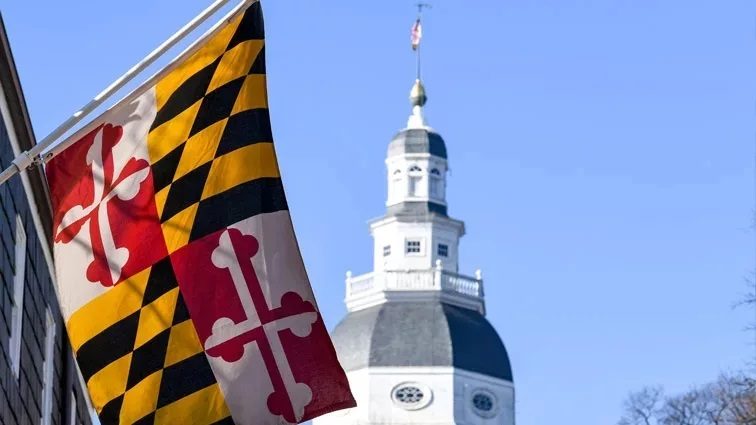
Question 3 on the November 2026 ballot asks Marylanders to amend the state constitution as it pertains to drawing Congressional districts.
But the question almost didn’t make the ballot after two Maryland judges ruled to block it based on language, among other reasons.
In plain language, Question 3 asks Marylanders whether to amend the state constitution to create separate standards for drawing the state’s congressional and state legislative districts.
A “yes” vote on Question 3 would make three changes:
In August 2025, Maryland Gov. Wes Moore ordered the state’s map to be redrawn after the Trump administration launched a national effort to redraw maps mid-decade to put more Republicans in Congress.
At that point, eight states — Alabama, Florida, Louisiana, Missouri, North Carolina, Ohio, Tennessee and Texas — had redrawn maps to help make it easier for Republicans to pick up seats due to the redistricting. New maps in California and Utah could give Democrats an advantage in six races.
In Maryland, the Governor’s Redistricting Advisory Commission drew a new map that reshaped the 1st and 3rd congressional districts in a way that could put Maryland’s sole Republican member of Congress at a disadvantage.
During Session 2026, the House passed the redistricting bill, but Senate President Bill Ferguson, D-District 46, blocked it after publicly disagreeing with the governor’s stance on redistricting.
Ferguson resisted taking redistricting under consideration during this year’s legislative session. Then in May, a U.S. Supreme Court ruling changed the Voting Rights Act, and Ferguson changed his mind.
New congressional maps are typically tied to the census and are drawn every 10 years.
In 2021, state lawmakers tried to redraw the maps in a way that made the 1st District on the Eastern Shore more competitive for a Democrat to win. Their efforts included drawing the district lines to include communities across the Chesapeake Bay (see map here).
In 2022, Judge Lynne Battaglia struck down those districts and issued a non-binding state court decision that applied to congressional districts the local standard. Under that standard, Maryland House and Senate districts must be compact and follow natural and/or jurisdictional boundaries. The judge’s ruling meant congressional districts must also follow those guidelines.
Judge Lynne Battaglia wrote in 2022:
“It is extraordinarily unlikely that a map that looks like the 2021 Plan could be produced without extreme partisan gerrymandering.”
Lawmakers convened a Special Session in August for House Bill 2100, which the Democratic majority ultimately approved by a 96-38 in the House and a 32-13 vote in the Senate. The governor signed the measure days later, sending the constitutional amendment question to the ballot.
Speaking at the bill-signing ceremony, the governor said:
“We cannot be caught flat-footed while we are watching the president of the United States engage in political redlining and gutting decades of progress that generations before us fought for. By passing this amendment, the General Assembly has ensured that Maryland remains committed to being part of this national conversation, and Maryland remains committed to ensuring that our voters will have the final say over what happens and nobody else.”
As passed, the question seeks to declare a constitutional requirement for only state legislative districts to be compact and take into account “natural boundaries.” The same would not apply for congressional districts.
If voters agree, it could clear the way for Maryland to produce new Democratic-leaning congressional maps in time for the 2028 election.
The Maryland Freedom Caucus, the conservative Oversight Project and two Republican state senators filed lawsuits in Anne Arundel and Dorchester counties, taking issue with the method the Democratic majority used to pass the measure and the phrasing of the referendum question itself.
| DOCUMENT: See full copy of the lawsuit
The Maryland Freedom Caucus said Democrats ignored a July 1 deadline to get the question on the November ballot and allow time for a public review. The lawsuits also claim Democrats disregarded the plain language requirement to purposely confuse voters.
Senate Minority Whip Justin Ready, R-District 5, said in a statement:
“This lawsuit is not about protecting politicians or political parties. It is about protecting the integrity of Maryland’s constitutional process. Every Marylander, regardless of political affiliation, should expect their government to follow the same laws it expects its citizens to obey.”
Democrats argued the ballot question is straightforward and they want voters to have a say.
Frederick County Delegate Kris Fair, D-District 3A, told WBAL-TV 11 News:
“It is a very clear-cut question that we’re trying to resolve here, and from our perspective at least, looking at the question itself, it is just clarifying what had already been understood for years and years and years prior to one judge’s opinion in 2022.”
Circuit court judges in Anne Arundel and Dorchester counties both ruled to block the ballot question, pending the state’s appeal straight to the Maryland Supreme Court.
In their decisions, the judges cited issues with the timing of the bill’s passage, the process used, and the wording of the ballot question.
| READ THE JUDGES’ OPINIONS: Anne Arundel County | Dorchester County
The judges ruled that lawmakers violated their own deadlines for ballot measures.
Anne Arundel County Circuit Court Judge Robert Thompson wrote in his opinion:
“The court finds that the process used by the General Assembly to propose ballot Question 3 was deficient. Further, in the General Assembly’s rush to pass the measure in hastily called special session the presumptions and thus the wording of the question itself are deficient.”
The judges took issue with the question’s language, saying the word “clarifies” found in the ballot question is “intentionally misleading.”
Dorchester County Circuit Court Judge S. James Sarbanes wrote in his opinion:
“There is no confusion that needed to be clarified … The language is misleading and does not provide voters with adequate information or an explanation for an informed vote.”
The Maryland Supreme Court ruled on Sept. 3 — the deadline for the Maryland State Board of Elections to send ballots to the printer — to allow the constitutional amendment question to appear on the ballot — but with different language.
The high court, in part, affirmed and reversed the circuit courts’ judgments. The justices agreed with the circuit courts on the basis that the ballot question is misleading and therefore violates due process requirements.
| ORDER: Supreme Court order and dissenting opinion
The Supreme Court ordered that the question be replaced with the language of the purpose paragraph, which reads:
“FOR the purpose of clarifying that certain requirements apply only to districts for the election of members of the Senate of Maryland and the House of Delegates; authorizing the General Assembly to grant original jurisdiction to the Supreme Court of Maryland to review the congressional districting plan of the state; and providing that nothing in the Maryland Constitution provides applicable criteria for the boundaries of a congressional districting plan.”
The justices found that the circuit courts erred in their rulings over whether the executive branch followed the Election Law Article and whether there was a violation of the state constitution’s single-subject requirement for the ballot question.
In the dissenting opinion, Maryland Supreme Court Justice Steven Gould questioned whether state election law authorizes the judiciary to draft ballot language. He wrote that the General Assembly “should bear the consequences of drafting a misleading (question). It’s not our job to rewrite the question for the General Assembly.” Gould also wrote that the question as rewritten by the majority of justices “remains misleading.”


